Best history books
The history books that appear most often among the recommendations catalogued by Cabeceira, selected based on their recurrence among publishable recommendations and on an editorial assessment that favors diversity of periods, scales, and approaches over mere count.
This list brings together history books — works that reconstruct and interpret events, periods, and processes from the past, rather than fiction set in another era — that appear most often in recommendations from people already catalogued by Cabeceira. It does not attempt to define a universal historical canon: it draws only on what is in Cabeceira's collection and on what real people with traceable recommendations have actually read and recommended.
Cabeceira's history collection has more qualified candidates than can fit in a list of 6 to 25 positions, so this selection deliberately favors diversity of period, scale, and approach rather than simply taking the titles with the most recommendations: it includes history at the scale of a species (the rise of large-scale human cooperation), history at the scale of a single event (an expedition to Antarctica), the economic history of a specific century, and history told through a single industrial biography. The order combines this emphasis on diversity with the frequency of publishable recommendations in the collection — frequency is a signal for inclusion, not the sole criterion for placement, and the methodology below explains exactly how the two are combined.
This list began with books in Cabeceira's collection classified in the history category, or clearly focused on reconstructing and interpreting real historical events, periods, and processes — deliberately excluding novels set in other eras, which also appear under the same theme in the collection but whose central premise is fictional rather than historical. Within this nonfiction subset, only titles with at least two publishable recommendations from distinct people were included; when the same author had more than one eligible title, only the more suitable of the two was included, so that a single author would not occupy too many positions in a selection intended to represent different periods and scales. Within the eligible set, each book's position combines the number of publishable recommendations it has in the collection with an editorial assessment that prioritizes diversity of historical period (from the Industrial Revolution to the 21st century), scale (from an entire civilization to a single expedition), and approach (data synthesis, narrative of an event, primary economic text, personal essay) — an explicit criterion given that this subset of the collection is larger than would fit in a list based on raw count alone. The list is revised whenever new relevant recommendations enter Cabeceira's collection or when a source used by one of the books is no longer publishable; the date of the most recent revision appears at the top of this page. One real limitation is that this list reflects only what Cabeceira has catalogued at a given time, and the diversity of period and approach sought here is limited to the history titles already present in that collection, not a complete overview of world historiography.
As an Amazon Associate I earn from qualifying purchases. Learn more..
- No. 1Sapiens: A Brief History of HumankindYuval Noah Harari
Harari organizes the entire history of the human species around three revolutions — cognitive, agricultural, and scientific — a framing that works less as an isolated philosophical argument and more as an exercise in large-scale periodization, of a kind that few other books in the collection attempt. It opens this list because it has the broadest base of distinct recommenders among the history books in the collection, serving as a maximum-scale starting point before the selection moves on to much more specific historical scopes.
Recommended by Anthony Pompliano, Bill Gates and 19 other people.
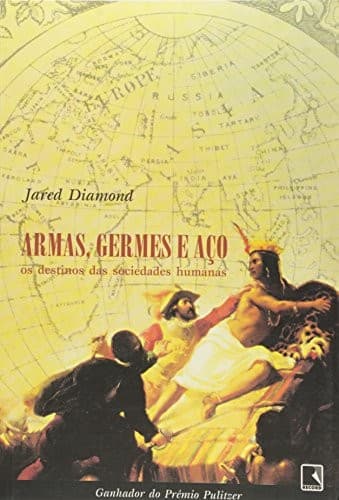
- No. 2Guns, germs, and steelJared Diamond
Diamond explains why certain societies conquered others not because of cultural or biological superiority, but because of unequal access to domesticable plants, farm animals, and geographic resources — an argument that shifts historical explanation away from the narrative of great men and toward material conditions over the very long term. It is included in this list because it offers a scale of analysis — geography as a historical force — that no other title in the selection addresses with the same degree of systematization.
Recommended by Bill Gates, Charlie Munger and 7 other people.
- No. 3The Lessons of HistoryWill & Ariel Durant
Will and Ariel Durant condense decades of historical research on religion, economics, and power into a deliberately short essay, a rare historiographical exercise that summarizes rather than expands. It is included in this list as the most extreme counterpoint in scale to the rest of the selection: where other titles here deal with a specific event or a single argument, the Durants try to synthesize patterns from all recorded history in a few dozen pages.
Recommended by James Clear, Kevin Systrom and 5 other people.
- No. 4Better Angels of Our NatureSteven Pinker
Pinker gathers centuries of data on war, homicide, and punishment to argue that violence among humans has declined consistently throughout history, even when everyday perception suggests otherwise. It is included in this list because it addresses a very long-term historical trend supported by quantitative data, a statistical approach to history that contrasts with the more qualitative readings of Diamond and the Durants in this same selection.
Recommended by Anthony Pompliano, Bill Gates and 5 other people.
- No. 5The rational optimistMatt Ridley
Ridley retells the economic history of humanity as a story of ever-widening trade and specialization, from prehistoric bartering to global production chains, arguing that commercial cooperation — not isolated accumulation — explains human material progress. It is included in this list because it addresses very long-term economic history through a specific thesis about the role of trade, complementing Pinker's argument about violence with a parallel argument about prosperity.
Recommended by Anthony Pompliano, Bill Gates and 4 other people.
- No. 6EnduranceAlfred Lansing
Lansing reconstructs, from period diaries and accounts, Ernest Shackleton's expedition to Antarctica between 1914 and 1917, after the ship Endurance was crushed by the ice — an account of extreme survival supported by rigorous historical research, not speculation. It's on this list as the smallest-scale scope in the selection, a single event spanning a few years, alongside titles that deal with entire centuries or millennia, showing that history is also made of specific, well-documented episodes.
Recommended by Jason Fried, Jordan Peterson and 3 other people.
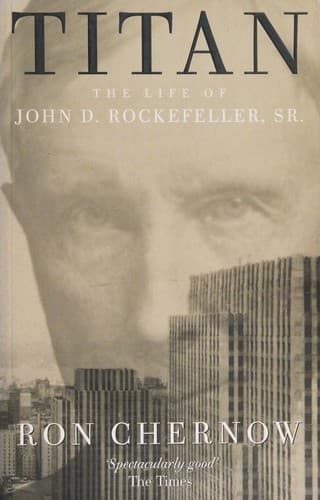
- No. 7TitanRon Chernow
Chernow uses John D. Rockefeller's trajectory to narrate the formation of the American oil industry and the rise of modern corporate capitalism, a period in which private fortunes and antitrust legislation were still being invented in parallel. It's on this list for telling economic and industrial history through a single central figure, functioning as a concrete case study of the more abstract forces discussed by Ridley and Gordon in this same selection.
Recommended by Anthony Pompliano, Charlie Munger and 2 other people.
- No. 8The Rise and Fall of American GrowthRobert J. Gordon
Gordon documents how United States economic growth accelerated extraordinarily between 1870 and the mid-20th century, driven by inventions such as electricity and sanitation, before slowing down in more recent decades. It's on this list for addressing a specific historical-economic scope — a century of a single country — with data that both support and question the very-long-term optimism of other titles in this selection.
Recommended by Bill Gates, Marc Andreessen and 2 other people.
- No. 9The Wealth of NationsAdam Smith
Written in 1776, at the height of the Industrial Revolution, Adam Smith's text on division of labor, specialization, and free markets is not just an economics treatise: it's a primary historical document about the moment when these ideas began reorganizing human production. It's on this list as the selection's only 18th-century primary source, offering the intellectual starting point for Ridley's and Gordon's more recent arguments about trade and growth.
Recommended by Elon Musk, Naval Ravikant and 2 other people.
- No. 10Between the World and MeTa-Nehisi Coates
Coates writes a letter to his own son about what it means to inhabit a Black body in the United States, weaving personal reflection together with the history of American racial violence from slavery to the present. It closes this list with a scope deliberately different from the others — not history seen from above, through aggregated data or a public figure, but history lived and passed down within a family, as a reminder that the very-long-term patterns discussed in the rest of the selection also carry a concrete individual cost.
Recommended by Barack Obama, Bob Iger and 2 other people.

Each book's position reflects both how often a publishable recommendation recurs and Cabeceira's own editorial review, described in the methodology above — it is not an automatic scoreboard or an internet consensus. Use each book's links to check who recommends it and the original or secondary source behind each mention before deciding what to read.
Edited by Adam Reis, founder and editorial lead at Cabeceira. Revised Jul 2026. Found a problem, or think a book belongs on this list? Send an editorial suggestion.