Best science fiction books
The science fiction novels and short stories that most often appear among the recommendations catalogued by Cabeceira, selected for recurrence among publishable recommendations and for their relevance in exploring technology, power, and identity through narrative, not through essays.
This list brings together the science fiction novels and short stories that most often appear in recommendations from people already catalogued by Cabeceira — from technology company founders to researchers, former heads of state, and artists. It does not attempt to define a universal canon of the genre: it is based only on what is already in Cabeceira's collection and on what real people, with traceable recommendations, have actually read and recommended.
The titles gathered here explore very different futures — totalitarian surveillance, lunar colonies in revolt, consciousness transferred to virtual worlds, social power inverted by a biological mutation — and so the list serves both those seeking the genre's foundational classics and those who have already read the most obvious names and want to go beyond them. This list deals specifically with works of narrative fiction; essays on futurism and technology that discuss speculative scenarios without building a plot or characters — even if they are catalogued under the same genre label in Cabeceira's collection — are not included here, because they are not, technically, fiction.
This list began with books in Cabeceira's collection classified as science fiction that are, in fact, works of narrative fiction — novels or short stories, with plots and characters. This excluded titles catalogued under the same genre label that are, in practice, non-fiction essays on futurism and technology, such as The Singularity Is Near and Life 3.0: Being Human in the Age of Artificial Intelligence. Within this subset of narrative fiction, only titles with at least two publishable recommendations from distinct people were included; when the same author had more than one eligible title — as with Ted Chiang, with Exhalation and Stories of Your Life and Others, and Neal Stephenson, with Snow Crash and Seveneves — only one was included, so that no author would occupy more than one position in a deliberately lean selection. In the tie between Chiang's two collections, the editorial choice prioritized Stories of Your Life and Others; between Stephenson's two novels, Snow Crash clearly had more recommendations than Seveneves. Each book's position is determined first by the number of publishable recommendations it has in the collection; within the same tier of recurrence, the order follows an editorial assessment of how the books complement one another across subgenres — space opera, classic dystopia, speculative fiction about artificial intelligence and consciousness. The list is revised whenever new relevant recommendations enter Cabeceira's collection; the date at the top of this page reflects the most recent editorial revision. One real limitation is that, because it includes only a still-modest subset of titles catalogued as narrative science fiction, this list is intentionally shorter than other Cabeceira lists and reflects only what is already in the collection at a given moment, not the genre's full universe.
As an Amazon Associate I earn from qualifying purchases. Learn more..
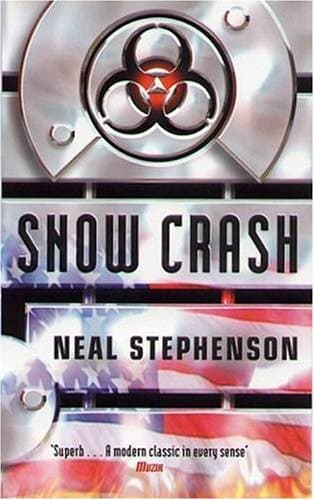
- No. 1Snow CrashNeal Stephenson
Stephenson imagines a commercial metaverse years before the term became a corporate cliché, and Hiro Protagonist — a pizza delivery driver and elite hacker — navigates between that virtual world and an America fragmented into private franchises. It opens this list because, among the science fiction works in the collection, it has the broadest base of distinct recommenders, many of them involved in building real technology decades after the book was published.
Recommended by Larry Page, Mark Zuckerberg and 4 other people.
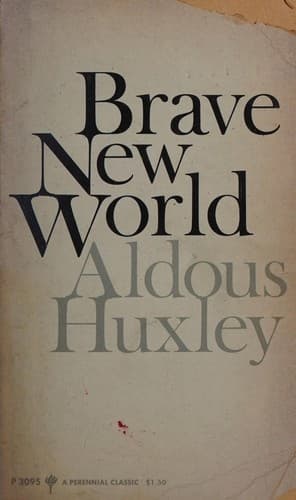
- No. 2Brave New WorldAldous Huxley
Huxley imagines the opposite of surveillance totalitarianism: a society that eliminates conflict and discomfort by trading freedom and meaning for chemical and social stability. It's on this list as a direct counterpoint to 1984 within the selection itself — two foundational dystopias that describe opposite paths to the same kind of control, one through pain, the other through pleasure.
Recommended by Jordan Peterson, Sam Altman and 2 other people.
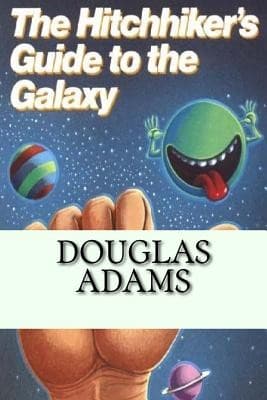
- No. 3Hitchhiker's Guide to the GalaxyDouglas Adams
Adams turns the destruction of Earth into the starting point of a cosmic comedy, using absurd humor to address, between the lines, bureaucracy, existence, and human insignificance on a galactic scale. It's on this list as the selection's most obvious tonal counterpoint — science fiction that prioritizes the joke over the warning, without giving up the serious speculation that underpins the genre.
Recommended by Elon Musk, Naval Ravikant and 2 other people.
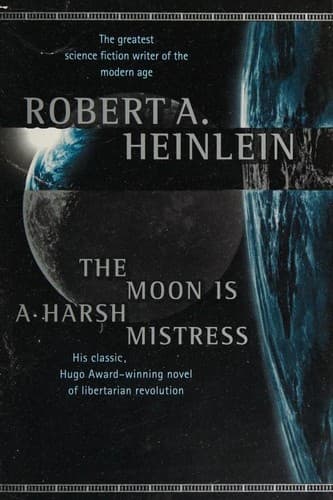
- No. 4The moon is a harsh mistressRobert A. Heinlein
Heinlein narrates the revolution of a lunar colony of exiles against Earth's political control, guided by an artificial intelligence that awakens to self-awareness over the course of the plot. It's on this list for addressing, as early as 1966, self-governance, orbital surveillance, and the rights of non-human beings with a political sophistication that remains relevant to the genre decades later.
Recommended by Bill Gates, Elon Musk and one other person.
- No. 5Arrival (Movie Tie-in edition)Ted Chiang
Chiang gathers stories that start from a precise scientific or linguistic question — what it means to perceive time differently, what would happen if physics allowed communication with one's own past — to arrive at entirely human dilemmas about free will, loss, and choice. It's on this list as the representative of contemporary science fiction short stories in the selection, a shorter and more rigorously scientific form than the novels surrounding it here.
Recommended by Naval Ravikant, Patrick Collison and one other person.
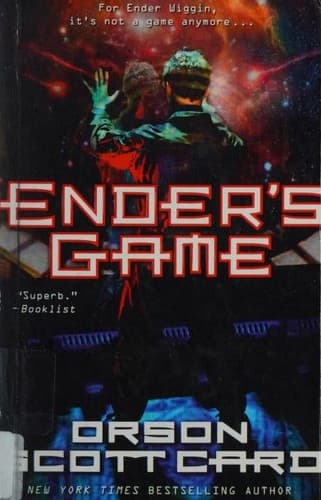
- No. 6Ender's GameOrson Scott Card
Card recruits a prodigy boy for an orbital military school that trains children to command battles against an alien threat, building the entire plot around a twist about what the protagonist was actually doing the whole time. It's on this list for directly addressing leadership, strategy, and the moral consequences of decisions made by someone who doesn't yet fully understand his own power, an angle that sets this title apart from the more adult novels in the selection.
Recommended by Mark Zuckerberg, Tim Ferriss and one other person.
- No. 7PowerNaomi Alderman
Alderman inverts, through an electrical power that awakens in teenage girls, the structure of physical power that sustains entire social hierarchies, asking whether this inversion truly liberates or merely swaps who oppresses whom. It's on this list as the most recent title in the selection and the only one centered on a sudden biological change rather than built technology, broadening the type of speculation represented here.
Recommended by Barack Obama and Bill Gates.
- No. 8Permutation CityGreg Egan
Egan follows a programmer who creates digital life forms and one of the first humans to transfer his own consciousness into a virtual world, using this premise to investigate with near-philosophical rigor what sustains identity when the body stops being part of the equation. It's on this list as the most technically dense title in the selection, aimed at readers who already know the genre and want harder speculation on computation and consciousness.
Recommended by Naval Ravikant and Tobi Lutke.
- No. 9Player of GamesIain M Banks
Banks sends Jernau Gurgeh, a master of a strategic game, into a rival empire whose entire political structure is decided by a single match, turning a novel about games into a study of how power systems disguise themselves as fair competition. It closes this list by representing the genre's political space opera, a subgenre the more introspective titles gathered here don't cover on their own.
Recommended by Lex Fridman and Mark Zuckerberg.

Each book's position reflects both how often a publishable recommendation recurs and Cabeceira's own editorial review, described in the methodology above — it is not an automatic scoreboard or an internet consensus. Use each book's links to check who recommends it and the original or secondary source behind each mention before deciding what to read.
Edited by Adam Reis, founder and editorial lead at Cabeceira. Revised Jul 2026. Found a problem, or think a book belongs on this list? Send an editorial suggestion.