Best Economics Books
The books on economics, economic history, and incentives that appear most often among the recommendations catalogued by Cabeceira, selected based on their recurrence among publishable recommendations and their relevance to understanding how societies, markets, and institutions actually work — rather than how to allocate one's own money.
This list brings together the books on economics, economic history, and the incentives that shape markets and institutions that appear most often in recommendations from people already catalogued by Cabeceira — from award-winning economists and technology-company founders to executives and investors. It does not attempt to cover all available economic literature: it draws only on what is already in Cabeceira's collection and on what real people with traceable recommendations have actually read and recommended.
This list addresses economics in a broad, historical sense — why some nations prosper while others do not; how a seemingly simple logistical innovation like the shipping container reshapes world trade; and how poorly designed incentive systems distort decisions across an entire society — rather than personal finance or investment strategy, a topic already covered by Cabeceira's separate list of the best investment books. Those looking to allocate their own capital should consult that list; this one is for those who want to understand the larger economic forces shaping companies, countries, and entire markets.
This list draws on the books in Cabeceira's collection classified in the economics category, with a deliberate focus on economic history, development, growth, and incentives — rather than personal finance or investment strategy, a topic already covered by the separate list of the best investment books. This excluded titles such as The Psychology of Money, which focuses on individual investor behavior and already appears on that other list. Within this subset, only titles with at least two publishable recommendations from distinct people were included. When the same author had more than one eligible title — as with Nassim Taleb, who has four candidate titles in the collection — only one was included, selected because it most directly addresses incentives and economic accountability (Skin in the Game), rather than risk and probability in broader terms, a topic already covered by Antifragile in Cabeceira's separate list of the best philosophy books. Each book's position is determined first by the number of publishable recommendations it has in the collection; within the same tier of recurrence, the order follows an editorial assessment of how the books complement one another, grouping, for example, those dealing with comparative economic development side by side. The list is revised whenever new relevant recommendations enter Cabeceira's collection; the date at the top of this page reflects the most recent editorial revision. One real limitation is that this list reflects only what is already catalogued by Cabeceira at a given time, not the full universe of economic literature these people have publicly recommended anywhere.
As an Amazon Associate I earn from qualifying purchases. Learn more..
- No. 1The rational optimistMatt Ridley
Ridley argues that exchange and specialization, rather than isolated individual talent, are the real engines of human progress throughout history, drawing on evidence from different eras to challenge narratives of inevitable decline. It opens this list because, among the clearly economics-focused books in the collection, it has the broadest base of distinct recommenders, serving as an optimistic entry point to a selection largely concerned with why societies prosper or stagnate.
Recommended by Anthony Pompliano, Bill Gates and 4 other people.
- No. 2The Wealth of NationsAdam Smith
Smith formalized, as early as 1776, the principles of the division of labor and free markets that still shape much of contemporary economic debate, arguing that self-interest and competition can, under the right conditions, produce collective well-being. It earns a place on this list as the foundational text of modern economics in the collection, a direct reference point for virtually every other book in this selection, even when they disagree with it on specific points.
Recommended by Elon Musk, Naval Ravikant and 2 other people.
- No. 3The Rise and Fall of American GrowthRobert J. Gordon
Gordon reconstructs two centuries of American economic history to argue that certain inventions — electricity, sanitation, the automobile — generated a leap in well-being that more recent innovations are unlikely to repeat. It is on this list for bringing a skeptical, well-documented counterpoint to the technological optimism present in other titles in the selection, treating economic growth as something historically specific, not a guaranteed trend.
Recommended by Bill Gates, Marc Andreessen and 2 other people.
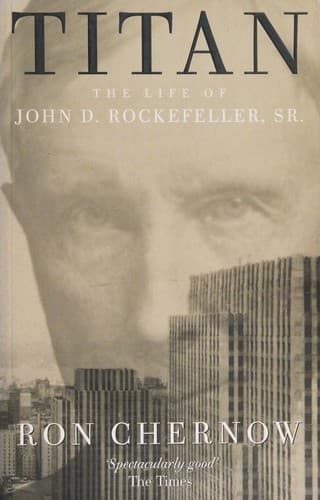
- No. 4TitanRon Chernow
Chernow reconstructs Rockefeller's rise at the head of Standard Oil and the antitrust battles that resulted from his near-monopoly, without simplifying the contradictions between the subject's business greed and deep religiosity. It enters this list as the only title centered on a single personal trajectory, illustrating on an individual scale much of the economic forces — market concentration, regulation, philanthropy — discussed more abstractly by the other books in the selection.
Recommended by Anthony Pompliano, Charlie Munger and 2 other people.
- No. 5Skin in the GameNassim Taleb
Taleb argues that economic decisions made by those who do not bear the consequences of their own actions tend to cause disproportionate harm, from fund managers to bureaucrats, proposing that having "skin in the game" is a condition for reliable judgment in any system. It is on this list for dealing directly with incentives — the thread connecting much of the other titles in this selection — more explicitly and systematically than any other book in the collection on the subject.
Recommended by Ben Horowitz, Changpeng Zhao and one other person.
- No. 6Changing World OrderRay Dalio
Dalio examines historical cycles of the rise and fall of economic powers, arguing that debt, technological innovation, and internal conflict follow recognizable patterns across centuries, from ancient empires to the current dispute between the United States and China. It enters this list for bringing the broadest macroeconomic and geopolitical lens of the selection, placing the other books — focused on a single country, era, or institution — within a longer-term cyclical panorama.
Recommended by Arianna Huffington, Changpeng Zhao and 3 other people.
- No. 7The Great trasformationKarl Polanyi
Polanyi argues that the self-regulating market is not a natural state of society, but a recent historical construction that deliberately broke with traditional social structures, a thesis written in 1944 that remains central to the debate on the role of the state in the economy. It is on this list for offering the most direct theoretical counterpoint to Adam Smith within the selection itself, questioning the premise that free markets emerge spontaneously without institutional intervention.
Recommended by Noam Chomsky and Satya Nadella.
- No. 8How Asia WorksJoe Studwell
Studwell compares the land reform, education, and controlled market access policies that allowed East Asian countries to escape poverty in a few decades with the unrestricted free-trade model frequently recommended by Western institutions. It enters this list as the selection's most concrete case study on economic development, testing the more abstract principles discussed by the previous books against real, recent examples.
Recommended by Bill Gates and Patrick Collison.
- No. 9Great EscapeAngus Deaton
Deaton, a Nobel Prize-winning economist, investigates why some populations escaped poverty and premature death while others were left behind, treating this gap as the central economic problem of the last two centuries. It is on this list for directly examining the inequality between nations that the more optimistic books in this selection tend to treat only in passing, without abandoning the argument that real progress has indeed occurred.
Recommended by Bill Gates and Jordan Peterson.
- No. 10Against the godsPeter L. Bernstein
Bernstein reconstructs how humanity developed, over centuries, mathematical tools for dealing with uncertainty — from marine insurance to futures markets — treating the very ability to quantify risk as one of the forces that made the modern economy possible. It closes this list by returning to a question that runs through practically every book gathered here: how do societies and institutions decide what is worth risking, and based on what information?
Recommended by André Valle, Howard Marks and one other person.

Each book's position reflects both how often a publishable recommendation recurs and Cabeceira's own editorial review, described in the methodology above — it is not an automatic scoreboard or an internet consensus. Use each book's links to check who recommends it and the original or secondary source behind each mention before deciding what to read.
Edited by Adam Reis, founder and editorial lead at Cabeceira. Revised Jul 2026. Found a problem, or think a book belongs on this list? Send an editorial suggestion.